Chores are my favorite.
There is actually some truth in that statement. Personally, I love clean, empty counters and everything tidy and in its assigned spot. I also have a senior in high school and a child in college, so the chore expectations in my house likely look very different from yours if you are reading this.
When my children were toddlers, it was a completely different story. If anything made it back to its assigned spot at any point during the week, I considered that a win.
Having young children in the house requires a tremendous amount of attention, support, and flexibility. That can be even more true when you have a child with developmental differences or additional support needs.
One of my favorite ways to increase engagement for our patients at home is to include them in chores and everyday routines that are already happening. Parents often do not think about involving their young child in these activities, particularly when the child may need more support to participate.
When I ask parents, “What chores does your child have or participate in?” the answer is often, “None.”
The reasons usually sound something like this:
“They are kids. They should just play.”
“They have therapy all day. They need downtime.”
“It is easier to do it myself after they go to sleep or while they watch television.”
There is a lot of truth in all of those statements. But there are also meaningful opportunities hidden inside everyday chores.
“They Are Kids. They Should Just Play.”
Absolutely. Play is incredibly important during early childhood.
It is also developmentally appropriate for young children to imitate what they see adults doing. Doll play, pretend kitchens, toy vacuums, and other household play themes are found in nearly every preschool classroom because children are naturally interested in the routines they observe around them.
Some children with autism may need additional structure and support to engage in play. Their independent play may be brief, repetitive, or difficult to sustain. Children with more significant play deficits may disengage from the people and activities around them unless an adult helps them remain involved.
This is one reason everyday chores can be so valuable.
Helping you unload groceries, move laundry into the dryer, wash fruit, or wipe the table gives your child a clear role and a natural reason to stay engaged with you and their environment.
The goal is not to turn chores into formal therapy. The goal is to create another opportunity to participate, connect, and learn within real life.
“They Need Downtime.”
That may be completely true. The important question is: What does downtime look like for your child, and how much do they need?
For many children, independent play, looking at books, listening to music, or watching a favorite show can provide a needed break. Downtime is important, especially after a long day of school, therapy, or other demands.
At the same time, not every moment outside of therapy needs to be completely independent or passive.
Simple, predictable routines can sometimes provide a reset while still allowing your child to remain involved. Closed-ended activities with a clear beginning and end may feel especially manageable. This may be more play-based like a puzzle, a shape sorter, or a book OR more chore-based like putting silverware in a drawer, placing napkins on the table, or moving wet clothes into the dryer.
These activities are brief, concrete, and easy to repeat. They can provide structure without requiring a long period of sustained attention.
“It Is Easier to Do It Myself.”
One hundred percent. This will almost always be true, especially in the beginning.
If you include your child in washing fruit, it may take twice as long. Several pieces may be eaten before they make it into the bowl. You may end up with water on the floor.
That is particularly likely the first several times you involve them.
Initially, including your child requires you to shift your goal. Instead of focusing only on completing the task as quickly and efficiently as possible, you are creating an activity that the two of you can experience together.
With repetition, your child may begin to understand their role and learn the sequence.
They may learn that the wet clothes go into the dryer, the dog food goes into the bowl, or the clean spoons go into the drawer. What begins as a messy and highly supported interaction can gradually become a familiar routine.
Start With Participation, Not Independence
Parents sometimes assume a chore only “counts” if their child can complete it independently. That is not the expectation.
Your child may begin by participating in only one small part of the routine.
They might:
Hand you one item at a time
Carry something across the room
Push a button
Pour with your help
Put an item into a container
Wipe one small section of a surface
Make a choice between two items
Help you complete the final step
You can provide as much support as needed. You might model the action, use gestures, simplify the directions, position materials so the next step is obvious, or complete the task together.
Over time, you can adjust the amount of help you provide based on your child’s success.
Chore Ideas for Young Children
The best routines are usually the ones that are already happening in your home. You do not need to create an elaborate chore system or add more tasks to your day.
Consider where your child could have a small, meaningful role.
These do not have to be completed perfectly. Participation is the goal.
wash fruits or vegetables
throw away wrappers
stir ingredients
place books on a shelf
put dirty clothes into a basket
help pack a backpack
Keep It Positive and Connected
At Springling, we are big fans of the NDBI Navigator. Jamie has created an incredible collection of NDBI resources for both parents and professionals, and we regularly use her materials.
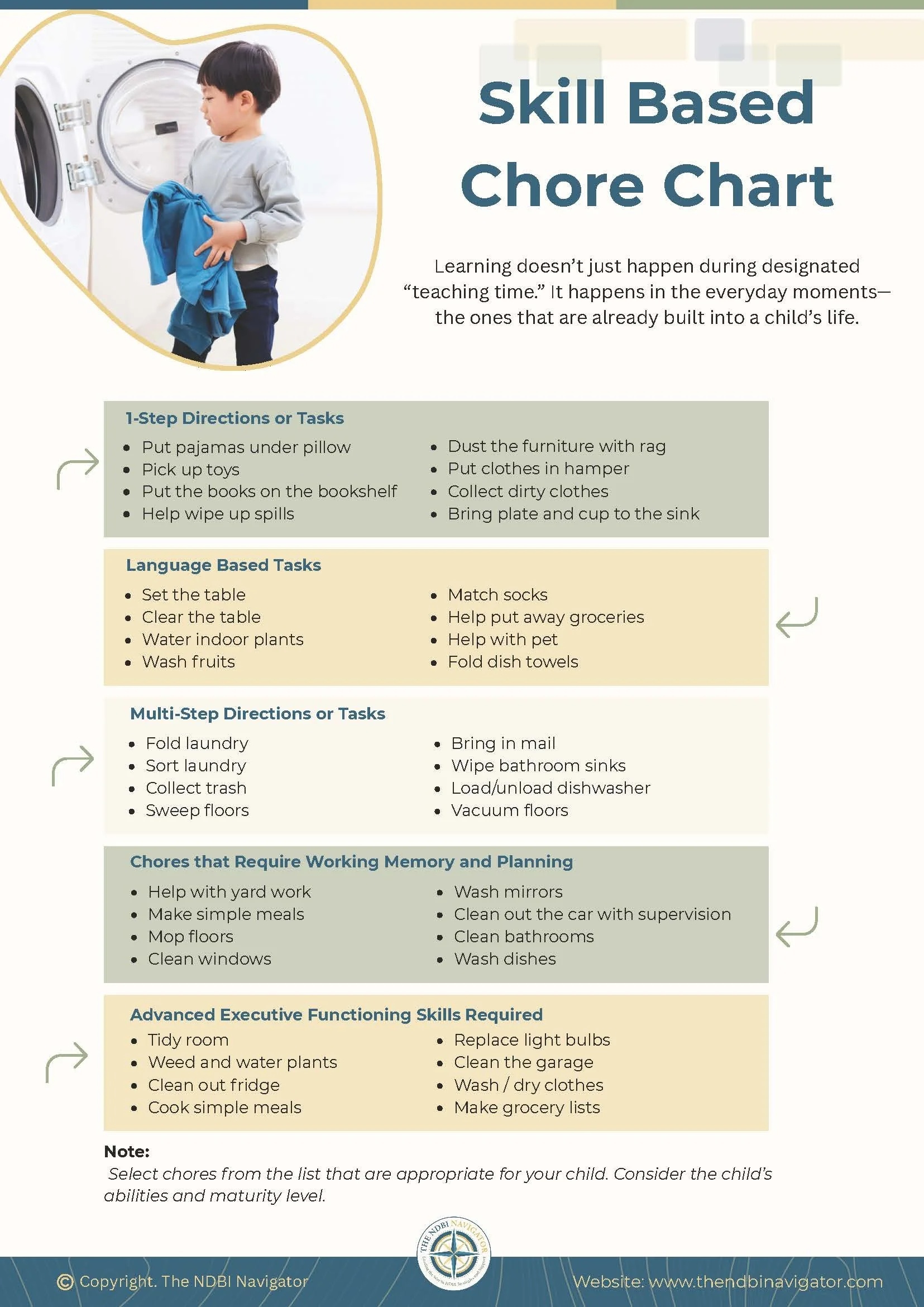
One of my favorites is the Skill-Based Chore Chart, which she has given us permission to share below.
The chart can help families think beyond a child’s age and instead consider the individual skills involved in different household routines.
Most importantly, remember that NDBI is rooted in connection, shared engagement, and learning within natural activities.
Including your child in chores is not about giving them more work. It is about giving them a role.
When your child helps you wash fruit, feed the dog, move laundry, or set the table, they are not only learning a household task. They are noticing what is happening around them, responding to another person, following a familiar sequence, communicating, making choices, and experiencing what it means to be part of the family routine.
Adding your child to the chores and activities that already happen each day can meaningfully increase their engagement with you and with their environment.
It may require you to slow down, tolerate some mess, and temporarily move away from quick task completion. But it also creates repeated opportunities to do something together.
And in NDBI, connection is always a win.
Carrie